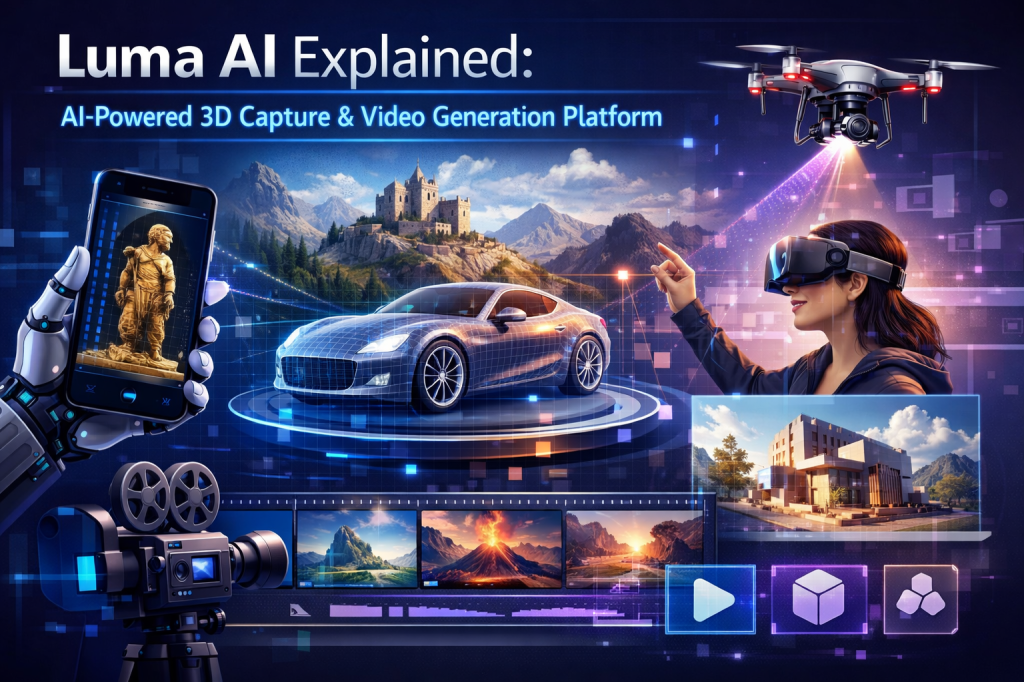
Creating high-quality 3D visuals and cinematic videos once required expensive equipment, advanced software, and technical expertise. From capturing real-world environments to rendering realistic scenes, the process was complex and often limited to professionals in gaming, film, or design industries.
However, things have changed rapidly. With the rise of artificial intelligence, 3D content creation and video generation have become faster, more accessible, and scalable. Today, AI tools can transform real-world objects and environments into immersive digital experiences using just a smartphone.
That’s where platforms like Luma AI come into play. Instead of relying on heavy 3D software or costly hardware, Luma AI simplifies the entire process—allowing users to capture, generate, and render high-quality 3D scenes and videos with ease.
Because of the growing demand for immersive content—especially in AR/VR, gaming, marketing, and eCommerce—tools like Luma AI are becoming essential rather than optional.
What is Luma AI?
Luma AI is an AI-powered platform designed to create realistic 3D models and cinematic videos from real-world inputs. It uses advanced technologies like Neural Radiance Fields (NeRF) to reconstruct scenes with high realism.
It allows users to capture objects, spaces, or environments using a smartphone and convert them into detailed 3D assets or videos without requiring advanced technical knowledge.
The platform is especially useful for:
- Content creators
- Game developers
- AR/VR creators
- Marketers
- Designers
By automating complex 3D workflows, Luma AI helps users create immersive content faster and more efficiently.
Why Do You Need Luma AI Alternatives?
While Luma AI is powerful, it may not be ideal for everyone. Users might explore alternatives due to:
- Limited manual editing control
- Requires good-quality capture for best results
- Processing time for complex scenes
- Not a full replacement for advanced 3D tools
- Limited customization compared to professional software
Exploring alternatives helps users find tools that better match their creative needs and workflow preferences.
How AI is Transforming 3D & Video Creation
AI has completely changed how 3D and video content is created. Traditionally, the process involved:
- Manual 3D modeling
- Complex rendering setups
- Expensive hardware and software
- Advanced technical skills
Now, AI automates most of these processes.
Advantages of AI in 3D & Video Creation
1. Speed & Efficiency
AI can generate 3D scenes and videos much faster compared to traditional workflows.
2. Cost Reduction
No need for expensive cameras, scanners, or large production teams.
3. Accessibility
Even beginners can create 3D content using simple tools like a smartphone.
4. Realism
AI-powered rendering produces highly realistic outputs with accurate lighting and textures.
5. Innovation
Enables new use cases like virtual experiences, AR filters, and immersive marketing.
Key Features of Luma AI
- AI-powered 3D capture using mobile devices
- NeRF-based scene reconstruction
- Cinematic video generation
- Realistic lighting and texture rendering
- Easy export for AR, VR, and game engines
- Cloud-based processing
- Fast rendering and visualization
- No need for high-end hardware
Top Alternatives to Luma AI
If you’re exploring other tools, here are some popular alternatives:
1. Tagshop AI
Best for AI video ads and product-based video creation.
2. Runway ML
Best for AI video editing and generative video content.
3. Pika Labs
Great for quick AI-generated videos.
4. WaveSpeed AI
Multimodal platform for image, video, and audio generation.
5. Kaiber AI
Useful for stylized and creative video outputs.
Comparison Table
| Tool | Ease of Use | AI Capability | Best Use Case |
| Luma AI | Medium | Very High | 3D capture & cinematic video |
| Tagshop AI | Easy | High | AI video ads |
| Runway ML | Easy | High | Video editing & AI video |
| Pika Labs | Easy | High | Quick video generation |
| WaveSpeed AI | Medium | Very High | Multimodal content creation |
| Kaiber AI | Easy | Medium | Creative visuals |
Why AI Tools Are Better Than Traditional Methods
AI tools offer several advantages over traditional workflows:
- Faster content creation
- Automated 3D and video generation
- Reduced production costs
- Easy scalability
- Beginner-friendly approach
Instead of spending hours or days building 3D assets manually, users can now generate immersive content in minutes.
Common Use Cases of Luma AI
Luma AI is widely used for:
- 3D product visualization
- AR/VR content creation
- Game asset development
- Virtual tours and environments
- Marketing and immersive ads
- Social media content
FAQs
1. Is Luma AI free to use?
Yes, it offers limited free usage, but advanced features may require payment.
2. Can beginners use Luma AI?
Yes, the capture process is beginner-friendly, especially with mobile devices.
3. Does it support video creation?
Yes, it can generate cinematic videos from captured scenes.
4. Is it better than traditional 3D tools?
For speed and ease—yes. For deep customization—traditional tools are still better.
5. Who should use Luma AI?
Creators, developers, and marketers looking to create immersive 3D and video content.
Final Thoughts
AI is transforming how 3D and video content is created, making it faster, more accessible, and highly scalable. Platforms like Luma AI are leading this shift by simplifying complex workflows into easy, AI-driven processes.
While it may not fully replace professional 3D software, it’s an excellent solution for creators who want speed, realism, and ease of use.
If your goal is to create immersive 3D visuals and cinematic videos without heavy setup—Luma AI is definitely worth exploring.



Leave a comment